Time for Reflection, Security, and Personal Growth
Recherches Team of MKs, 26 October 2026, SR-508mks-54
An almost-full Moon invites reflection on emotional security, personal attachments, and the habits that may prevent individuals from moving forward.
Understanding the Lunar Phase
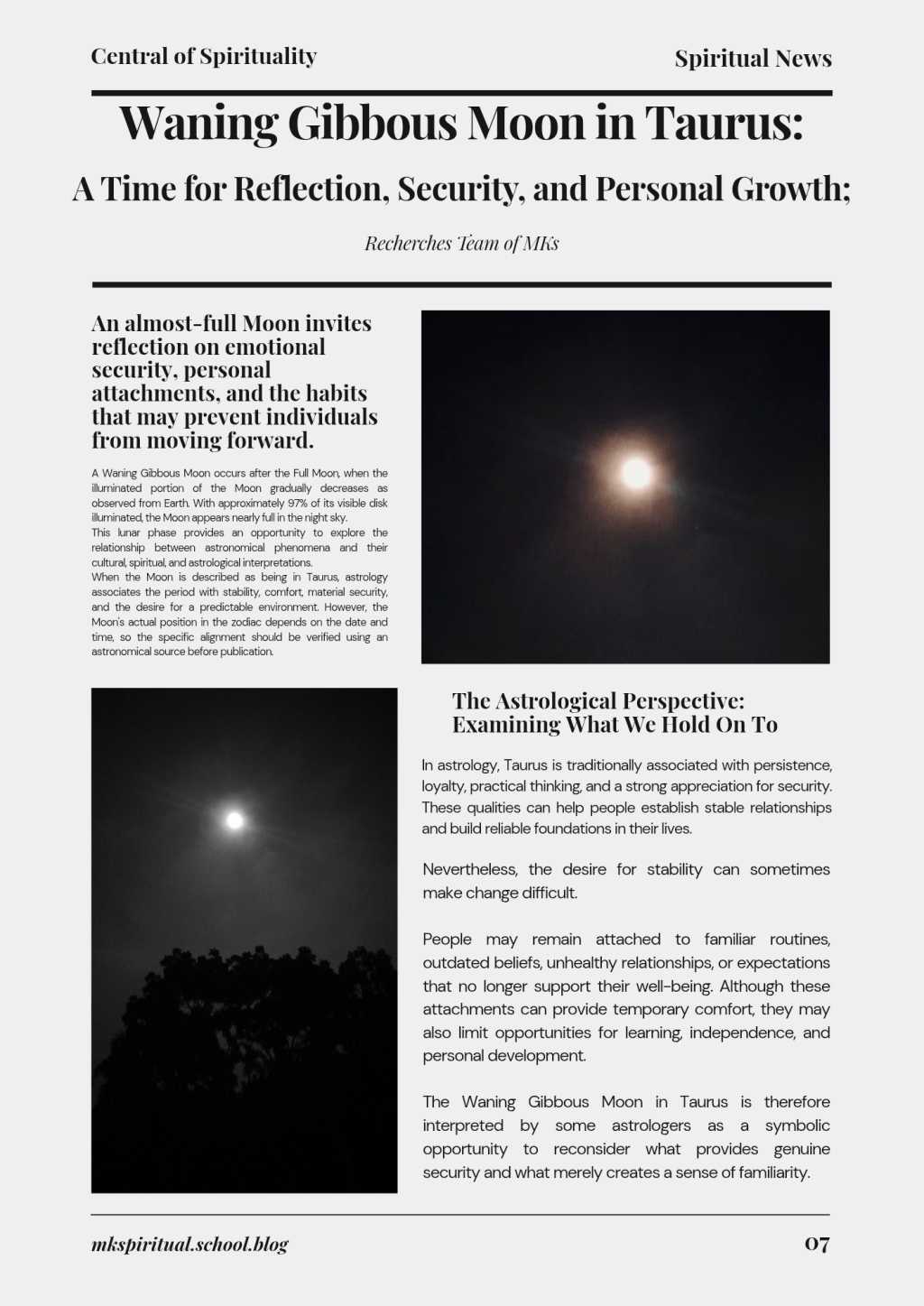
A Waning Gibbous Moon occurs after the Full Moon, when the illuminated portion of the Moon gradually decreases as observed from Earth. With approximately 97% of its visible disk illuminated, the Moon appears nearly full in the night sky.
This lunar phase provides an opportunity to explore the relationship between astronomical phenomena and their cultural, spiritual, and astrological interpretations.
When the Moon is described as being in Taurus, astrology associates the period with stability, comfort, material security, and the desire for a predictable environment. However, the Moon’s actual position in the zodiac depends on the date and time, so the specific alignment should be verified using an astronomical source before publication.
The Astrological Perspective: Examining What We Hold On To
In astrology, Taurus is traditionally associated with persistence, loyalty, practical thinking, and a strong appreciation for security. These qualities can help people establish stable relationships and build reliable foundations in their lives.
Nevertheless, the desire for stability can sometimes make change difficult.
People may remain attached to familiar routines, outdated beliefs, unhealthy relationships, or expectations that no longer support their well-being. Although these attachments can provide temporary comfort, they may also limit opportunities for learning, independence, and personal development.
The Waning Gibbous Moon in Taurus is therefore interpreted by some astrologers as a symbolic opportunity to reconsider what provides genuine security and what merely creates a sense of familiarity.
The central question is simple: Are we holding on because something continues to benefit us, or because we are afraid of what might happen if we let it go?
Emotional Security and the Challenge of Letting Go
Security is an important part of human life. Financial stability, supportive relationships, familiar surroundings, and consistent routines can contribute to a sense of safety.
However, genuine security does not necessarily mean keeping everything unchanged.
Personal growth often requires people to reconsider their assumptions, acknowledge mistakes, establish healthier boundaries, and accept that some circumstances will inevitably change.
From a psychological perspective, letting go does not mean abandoning responsibility or rejecting everything familiar. Instead, it involves recognizing when a habit, belief, or attachment has stopped serving a constructive purpose.
For example, a person may discover that the fear of failure is preventing them from pursuing an educational opportunity. Another may continue an unhealthy pattern simply because it has become familiar. In both situations, reflection can help identify the difference between reasonable caution and resistance to necessary change.
These are practical challenges that people can address regardless of their beliefs about astrology.
Releasing Habits That Limit Personal Development
The symbolism associated with this lunar phase can inspire several constructive practices:
Review personal habits: Identify routines that consume time and energy without contributing meaningfully to personal goals.
Reconsider emotional attachments: Reflect on whether relationships and commitments are based on mutual respect, trust, and healthy boundaries.
Question limiting beliefs: Examine assumptions about failure, success, money, and self-worth that may discourage positive action.
Appreciate stability without fearing change: Recognize that consistency can be valuable while remaining open to new possibilities.
Practice intentional decision-making: Replace impulsive reactions with thoughtful choices that reflect long-term values.
These practices do not require a particular spiritual or astrological belief. They are general approaches to self-reflection and personal development.
What Science Says About the Moon and Human Behavior
It is important to distinguish astronomical observations from astrological interpretations.
The Moon’s phases are scientifically established phenomena resulting from the changing relative positions of the Sun, Earth, and Moon. Its illumination can be calculated and observed.
Astrology, by contrast, interprets celestial positions symbolically. There is no strong scientific evidence that a Waning Gibbous Moon in Taurus directly causes people to reconsider relationships, release attachments, or experience particular emotional changes.
Consequently, the idea that this lunar phase encourages personal growth is best understood as an astrological theme or reflective framework rather than a scientifically established effect.
People may nevertheless use celestial events as reminders to pause, evaluate their priorities, and make thoughtful decisions.
A Broader Message: Growth Begins With Awareness
The Waning Gibbous Moon in Taurus offers a symbolic message about balancing stability with transformation.
Holding on to what is valuable can provide strength, but holding on to everything simply because it is familiar may prevent progress. The challenge is not to reject security, but to understand what genuine security means and whether existing habits support the life a person wants to build.
Sometimes, progress begins with a simple act of awareness: recognizing what needs attention, understanding why it has been difficult to change, and taking one realistic step toward improvement.
Whether viewed through astrology, spirituality, or ordinary self-reflection, the message remains relevant: Personal growth requires the wisdom to recognize what deserves to stay and the courage to reconsider what no longer serves us.

